An embargoed press release is a powerful tool in any PR pro's kit. It’s all about giving journalists a heads-up on your big news, with one simple condition: they can’t publish anything until a specific date and time you’ve set.
Think of it like giving a film critic an early screening. They get to see the movie before anyone else so they can write a thoughtful, detailed review, but they agree to hold their story until the official premiere date.
Understanding the Embargo Press Release

At its heart, an embargo is a handshake deal—a professional agreement between you and a journalist. You’re handing them valuable, time-sensitive news ahead of schedule, and they’re promising to honor the release time.
This lead time is the secret sauce. Instead of scrambling to churn out a quick blurb, reporters get the breathing room they need to do their job well. They can schedule interviews, gather extra data, and craft a story that’s both accurate and compelling. This helps turn a simple announcement into a rich, in-depth feature.
Why It Works: A Relationship Built on Trust
The whole system runs on trust. When you send a reporter an embargoed story, you’re basically saying, "I trust you with this information." When they accept it, they’re giving you their word they'll respect your timeline.
This professional courtesy is what lets you orchestrate a huge, coordinated launch. Picture your news dropping simultaneously across dozens of top-tier media outlets. That unified burst of coverage creates a massive "media moment"—far more powerful than a slow trickle of stories over several days.
The key goals of using a press release embargo are to:
- Secure Widespread Coverage: By giving every journalist an equal shot, you encourage more outlets to cover your story.
- Ensure Factual Accuracy: Extra time means fewer mistakes made by reporters rushing to beat a deadline.
- Create a Level Playing Field: It prevents one publication from scooping everyone else, which helps you build better long-term relationships with the media.
An embargo is a pact of patience. You give journalists the time they need to create quality work, and in return, you get the coordinated impact your news deserves. It's a win-win where thoughtful storytelling beats the frantic news rush.
A Time-Tested Tactic
Embargoes are anything but a new gimmick. Just look at science journalism, where major journals like Nature and Science have used embargoes as a core media policy since the 1920s. This system gives reporters pre-publication access to complex, peer-reviewed studies so they can write accurate articles that are timed perfectly with a study's official release.
Even in today's 24/7 news cycle, this tactic holds up. A Reuters Institute analysis confirmed that embargoes remain popular because they give journalists much-needed time while maximizing a story's impact. In the scientific community, over 90% of embargoed releases from top journals are honored, proving just how powerful and respected this system is.
For a clearer picture, let's look at how an embargoed release stacks up against a standard one.
Standard Press Release vs Embargo Press Release
Here’s a quick comparison to highlight the fundamental differences in timing, strategy, and what you can expect from each approach.
| Aspect | Standard Press Release | Embargo Press Release |
|---|---|---|
| Timing | Sent for immediate publication the moment it’s received. | Sent in advance with a specific future publication date and time. |
| Strategy | Aims for pure speed—getting the news out as fast as possible. | Aims for coordinated, high-impact, and in-depth coverage. |
| Reporter Experience | Can create a frantic race among journalists to publish first. | Allows reporters time to research, interview, and write a quality story. |
| Outcome | Often results in quick, brief news items or gets lost in the noise. | Tends to generate more detailed features and widespread, simultaneous coverage. |
Ultimately, the choice depends on your goal. If you just need to get information out quickly, a standard release works. But if you want to make a real splash and secure high-quality coverage, the embargo is your best bet.
When to Use an Embargoed Release
So, you’ve got big news. The big question isn't just what to announce, but how. Deciding whether to use an embargo press release is one of the most important strategic calls you'll make. It’s a specialized tool, and like any tool, using it right can build something great. Use it wrong, and you risk frustrating journalists and watching your big moment fall flat.
Think of it this way: some news is a quick text message, while other news is a formal, hand-written invitation. You wouldn't send an engraved card to announce you're running five minutes late. Likewise, an embargo is your formal invitation for news that needs—and deserves—a bit more ceremony.
The core question to ask yourself is simple: Does my news require time and explanation to be fully understood and appreciated? If you can’t say "yes" without hesitation, an embargo probably isn't the right play. A straightforward announcement is often best served with an immediate release.
The Right Time for an Embargo
An embargo truly shines when your announcement has some heft to it—it’s complex, significant, or has a lot of moving parts. These are the kinds of stories where journalists need a runway to get up to speed, connect the dots, and line up interviews to produce a piece with real depth.
You're in prime embargo territory with news like this:
- Complex Product Launches: If you’re rolling out a genuinely innovative technology or a product with a steep learning curve, reporters need time. Giving them an advance look lets them write an insightful review instead of just rewriting your spec sheet.
- Major Funding Rounds or Mergers: Announcing your Series C funding or a major acquisition is more than just a number. An embargo gives financial reporters the breathing room to dig into the deal, analyze the market impact, and talk to the key players.
- Groundbreaking Research or Data: When you’re publishing a study with game-changing findings, journalists need to properly digest the data, understand the methodology, and ideally, speak with the researchers. This is standard practice in scientific and academic circles for a reason.
- High-Profile Partnerships: A major collaboration between two big-name brands requires a ton of coordination. An embargo is the only way to make sure both PR teams, all executives, and the media are perfectly aligned for a unified, simultaneous launch.
For example, a company relaxing major international sanctions would be a prime candidate for an embargo. The news is complex, involves multiple government bodies, and has far-reaching economic implications that journalists need time to unpack before publishing.
In these situations, sending out an embargo press release a few days ahead of time is a sign of respect. It allows reporters to craft a much richer story, complete with compelling visuals and quotes from stakeholders. It helps them do their job better, which in turn, helps you.
When an Immediate Release Is Better
On the flip side, not every piece of news warrants the special handling of an embargo. For simpler, more direct announcements, an immediate release is faster, easier, and frankly, more appropriate. Slapping an embargo on minor news can come off as pretentious and wastes journalists' time.
Stick to an immediate release for these situations:
- Minor Company Updates: News like hiring a new non-executive team member, moving to a new office in the same city, or winning a small industry award doesn't need deep analysis. Get it out there and move on.
- Simple Event Announcements: If you're promoting a standard webinar or a local community event, an immediate release gets the word out quickly so people can actually sign up.
- Crisis Communications: When a crisis hits, speed and transparency are everything. Information must be released the moment it’s verified. Holding back critical updates with an embargo is a surefire way to erode public trust.
- Routine Financial Reports: While a landmark M&A deal benefits from an embargo, standard quarterly earnings reports are typically released immediately. This ensures all investors get fair and open access to the information at the same time.
The goal is to match your distribution strategy to the gravity of your news. Choosing the right tool for the job shows you respect the media's time and process. It's how you build a reputation as a savvy, professional PR partner they can trust.
How to Craft Your Embargo Press Release
Knowing when to use an embargo is the strategy, but knowing how to build one is the practical skill that keeps your announcement safe and your relationships with journalists solid. Get the formatting wrong, and you risk confusion and accidental leaks that can derail your entire launch.
The goal is to be unmistakably clear.
The single most important part of an embargoed release is the embargo notice. This isn't the place for subtlety. It needs to be the very first thing a journalist sees—right at the top, before your headline—and it has to be impossible to miss. Think bold, all-caps, and in-your-face.
This notice is a direct instruction, so there’s no room for fuzzy language. You have to be precise. Always include the full date, the exact time, and—this is crucial—the time zone.
EMBARGOED: FOR IMMEDIATE RELEASE AT 9:00 AM EDT ON TUESDAY, OCTOBER 26, 2026.
This format leaves zero room for error. The reporter knows exactly when they get the green light. A simple mistake, like leaving out the time zone, could lead a journalist in another region to publish hours before you’re ready.
The Anatomy of an Embargoed Release
Once you have the embargo notice locked in, the rest of the document is just a standard press release. The only real difference is that gatekeeping instruction at the very top. Reporters are used to this structure, so it helps them find the information they need fast.
Think of crafting the release as a simple, logical flow.
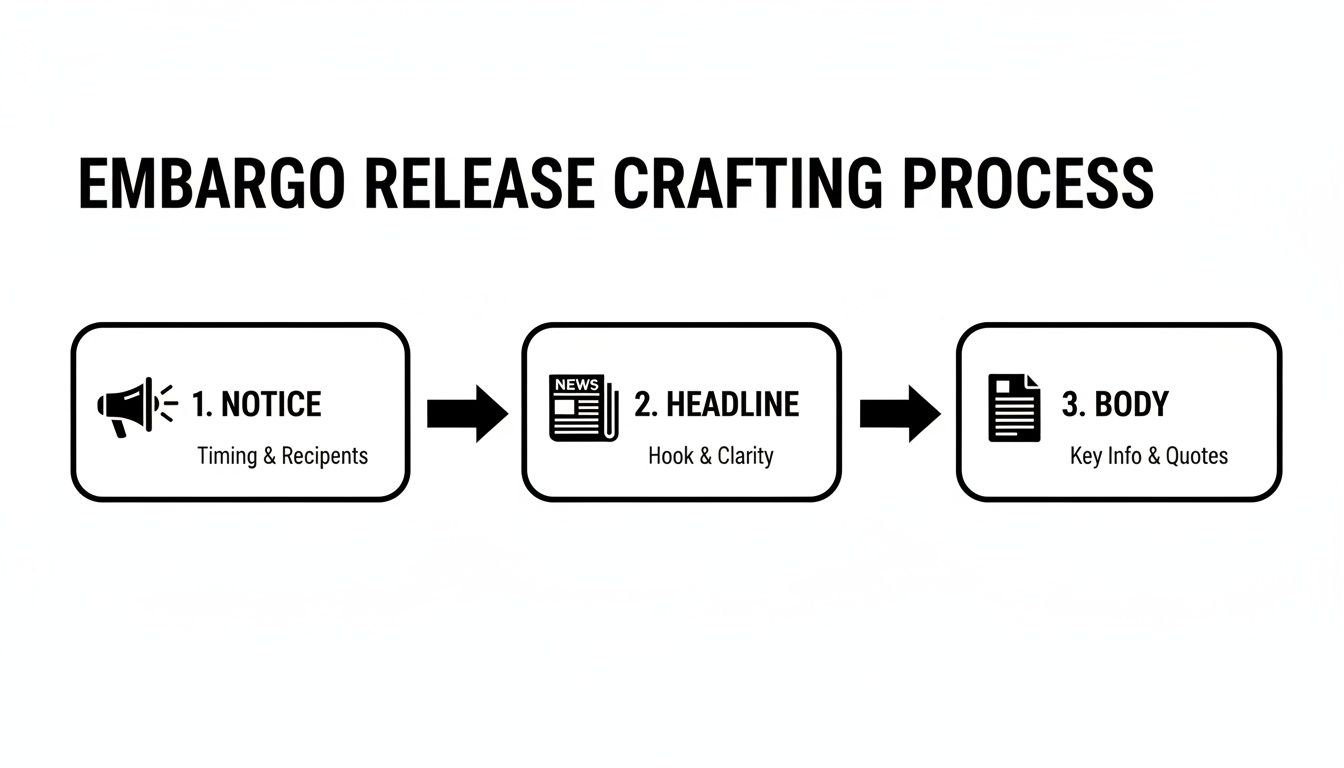
This process shows that the notice comes first, setting the rules of engagement before a journalist even gets to your big news. From there, the standard elements fall into place. If you need a quick refresher on the basics, you can check out our guide on the 8 key elements of a well-written press release.
Here’s how the structure breaks down:
- Embargo Notice: Your bold, all-caps instruction. Double-check it for accuracy before you even think about hitting send.
- Headline: This is your big hook. Make it compelling and get straight to the most newsworthy part of your story.
- Dateline: This includes the city and state where the news originates, plus the date you're sending the release (not the embargo lift date). For example: "NEW YORK, NY – October 23, 2026 –".
- Introduction: Your first paragraph needs to nail the "who, what, when, where, and why" right away. No beating around the bush.
- Body Paragraphs: Here’s where you add the details, context, and supporting facts. This is the perfect spot for powerful quotes from your CEO, a lead researcher, or other key figures.
- Boilerplate: A short, standardized paragraph at the end that gives a quick overview of your company. Think of it as your "About Us" elevator pitch.
- Media Contact: Include the name, title, email, and phone number for the person reporters can reach out to for more information or to set up an interview.
Putting It All Together: A Practical Example
Let's say a nonprofit is about to drop a major research study on urban green spaces. The data is complex and the findings are significant—a perfect candidate for an embargo.
Here’s what the top of their release would look like:
EMBARGOED: FOR IMMEDIATE RELEASE AT 10:00 AM PST ON MONDAY, NOVEMBER 8, 2026.
Headline: Groundbreaking Study Reveals City Parks Reduce Urban Air Pollution by an Average of 30%
SAN FRANCISCO, CA – November 5, 2026 – A new five-year study from the Urban Canopy Initiative has found that metropolitan parks play a far greater role in air quality than previously understood, actively removing up to 30% of common pollutants in surrounding neighborhoods.
From there, the release would dive into the body paragraphs with more data, quotes from the lead scientist, the boilerplate about the Urban Canopy Initiative, and the media contact details.
This structure ensures any journalist who opens the document immediately understands the rules before they get to the good stuff. By pairing a crystal-clear embargo notice with a standard press release format, you create a professional and effective tool for managing your big announcement.
Distributing Your Embargoed Release for Success

So you've crafted the perfect embargoed release. That's a huge win, but it's only half the battle. Your success now comes down to a flawless distribution plan.
A brilliant message means nothing if it doesn't land with the right people under the right conditions. This is where your strategy becomes the star of the show. It’s less about blasting your news into the void and more about surgical precision, building trust, and coordinating every moving part to stick the landing. Think of yourself as a director, not just a publicist, making sure every actor knows their cue.
Building Your Trusted Media List
The bedrock of any successful embargo is a media list built on quality and trust, not just numbers. You're looking for journalists and outlets with a proven track record of honoring embargoes and a genuine interest in your world.
Start by identifying the reporters who consistently cover your beat. Whose work do you admire? Who’s always reporting on your competitors? These are your prime targets.
Next, organize your list into tiers. This helps you prioritize your outreach.
- Tier 1: Your dream team. These are the highly respected, high-impact journalists you already have a solid relationship with.
- Tier 2: Reliable reporters who consistently cover your industry, even if you don't know them personally yet.
- Tier 3: Broader industry publications or local media that are relevant but less critical than your top-tier contacts.
Once your embargo press release is locked and loaded, you need to get it out there. Nailing down a strong content distribution strategy is key to making sure your message hits the right inboxes for maximum impact.
Securing the Embargo Agreement
This is the most critical step in the entire process. I'll say it again for the people in the back: Never send your full press release without first getting an explicit agreement to honor the embargo. Sending it unsolicited creates a free-for-all where no one is bound to your timeline.
You need to start with a "pre-pitch" email. This is a short, sharp message that teases the news without revealing the juicy details. Its only job is to ask one simple question: "Can you agree to an embargo?"
Here’s a simple template you can adapt:
Subject: Story under embargo from [Your Company Name]
Hi [Journalist’s Name],
I’m reaching out with some sensitive news from [Your Company Name] related to [General Topic, e.g., a major product launch, new funding round].
The story is under a strict embargo until [Date] at [Time] [Time Zone].
Please let me know if you can agree to these terms, and I'll send over the full press release and all the materials.
Thanks,
[Your Name]
Only after you get a clear "yes" should you send over the full package. This two-step dance protects your news and builds a foundation of professional trust.
Timing Your Pitch and Follow-Ups
With embargoes, timing is everything. Pitch too early, and your news gets lost in a crowded inbox. Pitch too late, and you defeat the whole purpose of giving journalists lead time. The sweet spot depends on how big and complex your announcement is.
Major, Complex News: (e.g., funding rounds, detailed research reports)
- Pitch: 3-5 business days in advance.
- Follow-Up: 24-48 hours before the embargo lifts. This is a quick check-in to confirm they have everything and to offer interviews.
Simpler Announcements: (e.g., a new high-profile hire, an event launch)
- Pitch: 24-48 hours in advance.
- Follow-Up: A quick note the morning the embargo lifts is usually plenty.
Using a wire service can also streamline this whole process, especially when you need to reach a wider audience. Many of the best press release distribution services have specific features to handle embargoed content, automating the final send at your designated time so you don't have to sweat it.
For startups and agencies, a well-timed embargo can boost media pickup rates by an impressive 40-60%. This disciplined approach ensures journalists are ready to go, making sure your launch makes the biggest splash possible.
Common Risks and How to Handle Them
An embargo press release is built on a foundation of trust. It's a handshake deal in a digital world. While that's its greatest strength, it's also where things can get dicey. The biggest risk you face is simple: a journalist breaks the embargo and publishes your news before you're ready.
This doesn't happen often with reputable journalists, but it does happen. When it does, your perfectly orchestrated launch can instantly turn into a chaotic scramble to play catch-up. Understanding this risk—and having a game plan—is what separates the pros from the rookies.
The Anatomy of an Embargo Break
So, what is an embargo break? It’s when a journalist or outlet publishes your story before the agreed-upon date and time. Sometimes it's an honest mistake—a scheduling error, a mix-up over time zones. Other times, it's a deliberate play to scoop the competition.
Whatever the reason, the fallout is the same. Your big announcement loses its punch, and every other journalist who respected the agreement now feels burned. That's a quick way to damage relationships you've worked hard to build.
Take the chaotic international closure of the BBC Sounds app in early 2025. An embargoed release was sent, but a mess of confusing public and private updates followed, leaving everyone frustrated. It's a textbook example of how a poorly managed embargo can implode, completely undermining the news it was meant to support.
So, what do you do when the worst happens and your news leaks early?
- Don't Panic. Assess the Damage: First, take a breath. Panicking won't fix anything. Figure out how big the leak is. Is it a small, niche blog or a major national outlet?
- Contact the Journalist and Their Editor: Get on the phone or email the reporter and their editor. Be polite but firm. Point out the error and ask them to pull the story. If it was a genuine mistake, most will comply immediately.
- Decide: Lift the Embargo for Everyone? If the cat's already out of the bag and the original outlet won't or can't retract it, your best move is often to lift the embargo for everyone. This levels the playing field and lets you salvage what you can of a coordinated push.
- Communicate With Your Full Media List: This is critical. Immediately email every journalist who received the embargo. Explain what happened, be transparent, and tell them the embargo is now lifted. Honesty here goes a long way toward preserving trust.
For a journalist who intentionally breaks an embargo, the professional consequences can be severe. They risk getting blacklisted by your company and, if word gets around, by other PR pros, too. While that doesn't undo the damage to your launch, it's a powerful deterrent. Navigating these tricky situations is a key skill, just like avoiding other common press release mistakes that can hurt your campaign.
Navigating the Ethical Tightrope
Beyond the risk of leaks, using an embargo press release walks an ethical tightrope, mainly around fairness. When you give advance information to a select group, you're inherently creating tiers of access. This has become a hot-button issue, especially when the news is market-sensitive.
For instance, the U.S. Bureau of Labor Statistics (BLS) and Department of Labor (DOL) famously stopped their "media lock-up" procedures back in 2020. These lock-ups were essentially in-person embargoes for critical economic data. The practice was halted because of concerns that it gave an "unfair competitive advantage" to some reporters and their clients. You can read more about the BLS's decision regarding media lockups on their official site.
This move by the BLS highlights a crucial point for any PR pro: you have to run a fair process. Offer the embargo to all the relevant outlets on your beat, not just a few of your favorites. When you treat all journalists equitably, you build a reputation for professionalism that minimizes both ethical headaches and the chances of a frustrated reporter leaking your news.
What to Do When the Embargo Lifts
The clock hits zero on your embargo. This isn't the finish line—it’s the starting gun for your public campaign. All the careful planning behind your embargo press release has led you to this moment. Now it's time to pivot from quiet coordination to active promotion and squeeze every bit of momentum out of your announcement.
Your very first move is simple: start monitoring everything. Fire up your alerts and begin searching for your story across news sites, blogs, and social media feeds. As articles pop up, track them in a spreadsheet. This becomes your mission control for gauging the campaign's reach and pinpointing the best coverage to amplify.
Take Control of the Narrative
As soon as media coverage starts rolling in, it’s vital to deploy your own assets. This ensures your official message is front and center, providing a central hub for anyone looking for more details. Don't let others tell your story for you.
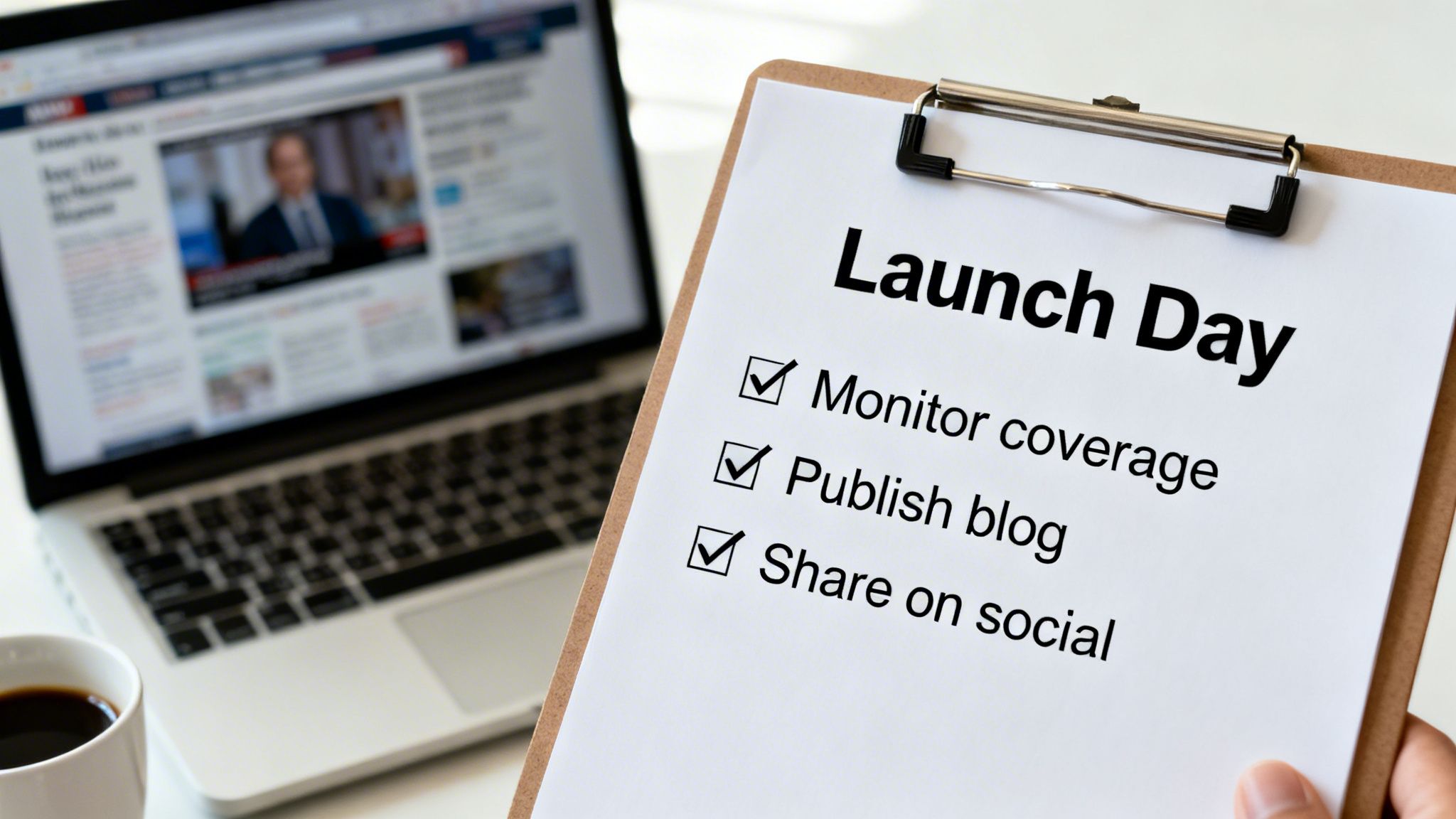
Here’s your immediate launch-day checklist:
- Publish the News: Get the press release live in the news or media section of your website.
- Create Original Content: Launch a companion blog post that adds color, context, and a personal voice to the announcement.
- Synchronize Social Media: Schedule a coordinated blast of posts across all your social channels, linking back to your blog or the strongest piece of media coverage.
The embargo lift is when you shift from entrusting your story to others to owning it publicly. Your blog and social channels are the first and best places to frame the announcement in your own words, making sure your perspective leads the conversation.
Amplify and Engage
Your job isn't over once the stories are published. The next phase is all about amplification and engagement, which is how you turn those initial press hits into lasting social proof and get the full value from your hard work.
For industries like real estate or retail, a well-played embargo can result in 2-3 times more media pickups compared to a standard immediate release, especially for major conference news. To make the most of this, you need a solid post-launch plan. You can learn more about how to turn potential PR risks into game-changers on istat.it.
Start sharing the best articles on your social media, and always remember to tag the journalist and their publication. A simple "thank you" goes a long way in building goodwill for your next big announcement.
Finally, repurpose glowing quotes and media logos as testimonials on your website and in your sales materials. This is how you maximize the ROI of your campaign long after launch day.
Frequently Asked Questions
Even seasoned pros have questions when it comes to the finer points of embargoes. Let's tackle some of the most common ones that land in our inbox.
How Far in Advance Should I Send an Embargoed Release?
This really boils down to how complex your story is.
For a major announcement—think a deep research report or a game-changing product launch—give journalists at least 3-5 business days. They’ll need that time to digest the material, conduct interviews, and write a quality story.
If your news is more straightforward, 24-48 hours is usually plenty of lead time. It's a balancing act: you want to give reporters enough time to do their job well, but not so much that your news gets buried in a crowded inbox.
What if a Journalist Will Not Agree to the Embargo?
Simple: do not send them the information.
The entire strategy hinges on that mutual agreement. If a reporter or their publication explicitly says they won't honor the embargo, you have your answer. Trying to force it is a rookie mistake.
It’s far better to leave one outlet off your initial pitch list than to risk a leak that torpedoes your entire coordinated launch. Focus your energy on the journalists who understand and agree to the terms. For more on communication strategies and the nuances of press releases, the Postbae blog is a great resource to explore.
Are There Risks if an Embargo Is Broken?
Absolutely, and the stakes can be incredibly high. A broken embargo doesn't just mean your launch gets spoiled; in some cases, it can have life-or-death consequences.
A stark example is when the UK's Ministry of Defence embargoed the news of Prince Harry's deployment to Afghanistan in 2007. A leak broke the story, forcing an immediate end to his tour and pulling him from the battlefield for his own safety. You can learn more about the history and risks of embargoes via istat.it.
Can I Use a Wire Service for an Embargo?
Yes, you can. Major distribution services like Business Wire or PR Newswire have reliable, built-in features for handling an embargo press release. You can set the exact date and time, and their system will hold the story until it's go-time.
However, a word of caution: while wire services are great for broad distribution, nothing beats direct, personal outreach for building strong, long-term relationships with the media.
At Press Release Zen, we provide the guides, templates, and expert advice you need to master media communications. Explore our resources to build your next successful campaign at https://pressreleasezen.com.