Key Takeaways
- Content strategy determines how you express your identity through various channels, while brand strategy establishes who you are.
- Companies that develop a clear brand strategy first often see better performance from their content marketing efforts.
- Most marketing failures stem from creating content without a foundational brand strategy.
- When aligned properly, brand and content strategies create a powerful feedback loop that strengthens customer relationships.
- AmpiFire helps companies amplify their brand message with strategic content distribution across multiple platforms. It uses its proprietary AI-powered technology to create eight distinct content formats and distribute them across a network of high-traffic sites.
Why Most Brands Get Content & Brand Strategy Backwards
Content strategy and brand strategy are often confused or used interchangeably, but they serve fundamentally different purposes in your marketing ecosystem.
Content strategy determines how you communicate your brand identity through blogs, videos, social media, and other channels to achieve specific business objectives. On the other hand, brand strategy defines who you are: your identity, values, positioning, and the emotional connection you build with your audience.
Understanding the distinction between these two approaches is essential for building a cohesive marketing foundation. When brand and content strategies align, every piece of content reinforces your identity and moves your audience toward action. When they’re misaligned, even high-quality content fails to build the recognition and trust your business needs.
This guide breaks down the key differences between brand and content strategy, provides real-world examples, and offers practical tips for leveraging both effectively.
Why Press Releases Don’t Work Anymore
Smart Businesses Are Moving Beyond Traditional PR
• The Problem: Press releases reach one audience through one channel while your customers are everywhere online. Most get buried within days with poor ROI.
• The Solution: AmpiFire’s AmpCast creates 8 different content formats from one topic and distributes across 300+ high-authority sites including Fox affiliates, Spotify, and YouTube.
What You’ll Learn on PR Zen:
✓ Why multi-channel content delivers 10x better results than press releases
✓ How to amplify your PR efforts across multiple platforms
✓ Real case studies of businesses dominating search, social, video, and podcasts
✓ Cost-effective alternative to expensive PR agencies
Ready to Replace Press Releases? Learn the AmpiFire Method →
Content Strategy Explained: Your Tactical Execution Plan
What Content Strategy Actually Includes (& What It Doesn’t)
Effective content strategy encompasses audience research, channel planning, content calendars, creation workflows, distribution tactics, and performance measurement frameworks. It provides systematic answers to questions about the messages you’ll deliver, the formats you’ll use, where you’ll publish, when you’ll release content, and how you’ll measure success.
What it doesn’t include are the fundamental brand decisions about purpose, positioning, and personality; these should be inherited from your brand strategy rather than created within your content planning process.
Content Strategy Components That Drive Results
The most effective content strategies contain four critical components that work together to create business impact. These include:
- Audience Journey Mapping: This identifies informational needs and emotional states at each customer lifecycle stage.
- Channel Prioritization: To determine which platforms will receive primary focus based on audience behavior and business objectives.
- Content Pillars: These establish the core topics and themes that align with both customer interests and brand expertise.
- Measurement Frameworks: To define key performance metrics (KPIs) for each content type and distribution channel, creating accountability for both engagement metrics and business outcomes.
Example of Content Strategy
HubSpot’s content strategy exemplifies how operational content decisions can flow from brand strategy while driving business results.
Its content centers around five core pillars—inbound methodology, sales techniques, marketing strategy, customer service excellence, and business growth—that align with both audience interests and HubSpot’s positioning as an educational leader.
The execution spans multiple formats optimized for different funnel stages: blog posts for early-stage prospects, academy courses for engaged leads, and research reports for decision-makers. Across these formats, HubSpot maintains consistent educational value, reinforcing its brand as the helpful authority in its space.
Brand Strategy Explained: The Foundation of Your Identity
Core Elements That Define Brand Strategy
Every comprehensive brand strategy addresses several essential elements that collectively define a company’s identity in the marketplace.
Purpose articulates why the company exists beyond making money, and the problem it solves or the positive change it creates. Positioning establishes where the brand stands in relation to competitors and how it occupies a distinctive place in customers’ minds.
Promise defines the consistent experience customers can expect when engaging with the brand, while personality brings the brand to life through character traits, voice, and visual identity.
These elements work together to create a coherent brand identity that resonates with target audiences.
The 5 Questions Every Brand Strategy Must Answer
A robust brand strategy answers five fundamental questions that define your organization’s market position. First, why does your brand exist beyond profit? This purpose drives decisions when market conditions change.
Second, who exactly are you serving? Effective brand strategies define target audiences with psychological and behavioral precision, not just demographics. Third, what makes you meaningfully different from competitors? This differentiation must be both authentic to your capabilities and relevant to customer needs.
The fourth question addresses how you deliver your unique value, the operational promise that customers can count on consistently. Finally, what personality traits make your brand recognizable and relatable? These character attributes should feel natural rather than forced, reflecting your organization’s authentic culture.
Example of Brand Strategy
Patagonia’s brand strategy illustrates how foundational brand decisions create distinctive market positioning.
Its purpose centers on environmental activism, expressed through its mission: “We’re in business to save our home planet.” This purpose informs everything from product materials to political advocacy. Its positioning occupies the intersection of premium outdoor performance and environmental responsibility.
This manifests in product choices that prioritize durability over replacement, sometimes explicitly discouraging unnecessary purchases. Its brand personality combines outdoor authenticity, environmental activism, and understated quality. Content strategy naturally extends from this foundation, focusing on environmental storytelling and opportunities for activism.
Key Differences Between Brand & Content Strategy

Decision-Making Authority: Who Owns Each Strategy
Content strategy usually falls under mid-level marketing leadership, such as Content Directors, Marketing Managers, or Digital Strategists. This operational-level ownership enables greater flexibility and responsiveness to market feedback.
Brand strategy, by comparison, typically resides at the highest levels of the organization, often stewarded by C-suite executives, including the CEO, CMO, or dedicated Brand Officer. Brand strategy approvals generally require executive sign-off, with significant changes undergoing rigorous review to ensure alignment with the company’s vision.
While content teams must operate within brand parameters, they typically have more autonomy in tactical execution, enabling them to test approaches and optimize based on performance data.
Scope & Focus Differences
Content strategy maintains a narrower focus on planned communications across owned, earned, and paid channels. While still substantial in scope, content strategy primarily concerns itself with information and experiences the marketing team directly creates or influences.
Brand strategy encompasses all company touchpoints, from product design and customer service to marketing communications and employee behavior. This comprehensive scope reflects the understanding that brand experience extends far beyond marketing content.
Every customer interaction, whether through official communications or operational experiences, shapes brand perception.
Success Metrics That Don’t Overlap

Content strategy performance manifests in more immediate and attributable metrics tied to specific assets and campaigns. These include engagement rates, conversion metrics, search rankings, and channel growth statistics.
Brand strategy success is reflected in metrics such as unaided awareness and perception attribute ratings. These indicators change gradually and reflect cumulative impact rather than immediate campaign effects.
Content Strategy vs Brand Strategy: Comparison Table
| Feature | Content Strategy | Brand Strategy |
| Primary Focus | How you communicate your message | Who you are as a business |
| Core Purpose | Drive engagement, traffic, and conversions through content | Define identity, values, and emotional connection with the audience |
| Key Question | “What content do we create and how do we distribute it?” | “What do we stand for and how do we want to be perceived?” |
| Scope | Tactical execution of content creation and distribution | Foundational positioning and long-term brand identity |
| Timeframe | Short to medium-term campaigns and content calendars | Long-term vision that evolves slowly over time |
| Deliverables | Blog posts, videos, podcasts, social media, and infographics | Brand guidelines, messaging framework, visual identity, positioning statement |
| Measures Success By | Traffic, engagement, conversions, search engine rankings | Brand awareness, perception, loyalty, recognition |
Bridging the Gap Between Strategy & Execution
Understanding the difference between content strategy and brand strategy is only half the battle. The real challenge lies in execution—consistently producing content across multiple channels while ensuring every piece reinforces your brand identity.
Most businesses face a resource dilemma: they can either create more content to expand their reach or invest time in ensuring brand consistency across fewer touchpoints. This trade-off limits growth and dilutes brand impact over time.
The companies that win are those that find ways to scale content production without sacrificing brand alignment. They use systems that maintain their voice, positioning, and messaging across every format and platform their audience uses.
How AmpiFire Amplifies Your Content Strategy While Strengthening Your Brand
A strong content strategy requires consistent execution across multiple channels, while brand strategy demands that every touchpoint reinforces your identity and messaging. AmpiFire bridges both by transforming a single piece of content into multiple formats and distributing them across channels where your audience already engages.
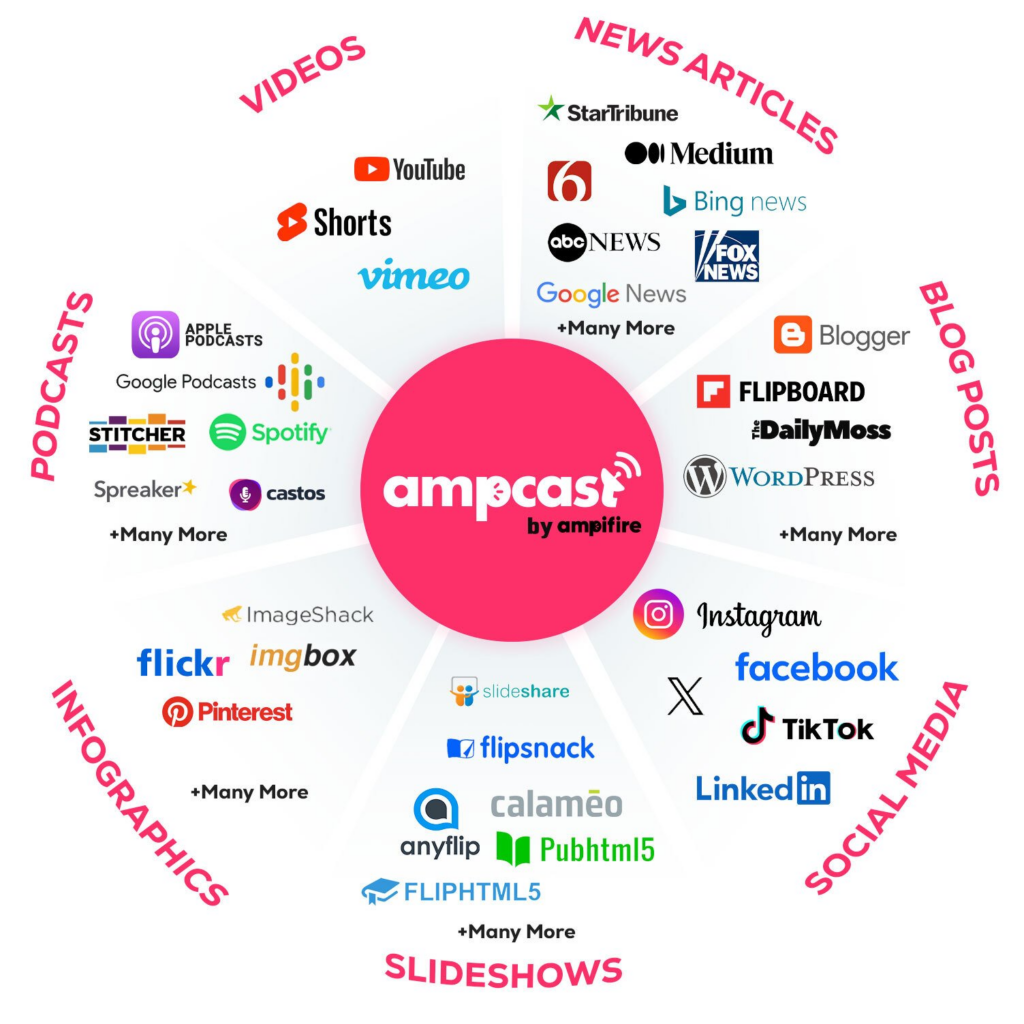
AmpiFire’s AI-powered AmpCast technology takes your core topic and creates eight different content formats: blog posts, news articles, podcast episodes, videos, slideshows, infographics, and social media content. Each format maintains your brand voice while adapting to platform-specific best practices. Distribution spans 300+ high-authority sites, including Fox affiliates and major news outlets.
Unlike traditional content that fades quickly, AmpiFire builds lasting digital assets that continue reinforcing your brand for months or years—turning your content strategy into a brand-building engine that grows more powerful over time.
This sustained growth demonstrates how consistent multi-format distribution simultaneously builds content visibility and brand authority. One of AmpiFire’s clients, an Oklahoma auto dealer, used AmpiFire to execute a content strategy that reinforced their brand across multiple channels. According to Semrush data, organic visitors grew from 1,449 per month in July 2021 to 2,559 by November 2022—a 76.7% increase.
This growth resulted from appearing across multiple channels, not just search, but also video platforms, podcasts, and high-authority news sites, creating compounding visibility that single-channel strategies can’t match.”
Notably, this case study is unique to this AmpiFire customer, and results may vary based on execution, niche, market, and other factors.
Ready to Unify Your Content & Brand Strategy? Try the AmpiFire Method →
Frequently Asked Questions (FAQs)
Can a small business have separate content and brand strategies?
Yes, even small businesses benefit from distinguishing between brand and content strategies, though the processes may be simplified. A small business brand strategy might consist of a one-page document outlining purpose, positioning, personality, and target audience. The content strategy would then detail specific topics, channels, and content types that express this brand foundation.
How do we measure the ROI of our brand strategy?
Brand strategy ROI is measured through multiple interconnected metrics rather than a single direct measurement. Primary indicators include reduced customer acquisition costs, increased customer lifetime value, sustainable price premiums versus competitors, and greater marketing efficiency through higher conversion rates.
Should the same team manage both content and brand strategy?
Ideally, these strategies have distinct but collaborating ownership. Brand strategy typically requires an executive-level perspective on market positioning and long-term business direction, while content strategy benefits from specialized expertise in communication channels and audience engagement.
How can AmpiFire help me unify my content and brand strategy?
AmpiFire’s AmpCast technology transforms your single topic into eight different content formats, each maintaining your brand voice while optimizing for different platforms. This multi-format approach executes your content strategy across 300+ high-authority sites while ensuring every touchpoint reinforces your brand identity consistently.
*Disclaimer: Results may vary based on individual circumstances, business type, and content strategy. The time savings and outcomes mentioned are based on typical user experiences and are not guaranteed. For specific pricing and service details, please visit AmpiFire.