Key Takeaways
- A strong call to action (CTA) in your press release can increase reader engagement when properly implemented.
- The most effective press release CTAs combine clear direction, compelling value, and a sense of urgency.
- Placing your CTA strategically at the end of your press release body creates maximum impact after readers understand your news.
- Testing different CTA variations can significantly improve conversion rates from press release traffic.
- Traditional press releases are limited to a single format on a handful of outlets. AmpiFire’s AmpCast AI takes a completely different approach — automatically transforming your announcement into 8 formats, optimizing each, and distributing them across 300+ sites so your message reaches audiences across multiple channels.
What is a Call to Action in a Press Release?
A call to action (CTA) in a press release is a specific instruction that directs readers toward a desired next step after consuming your news. It serves as the connective tissue between your announcement and measurable business outcomes. Unlike the neutral tone of your press release body, your CTA deliberately motivates readers through clear, action-oriented language.
The most effective press release CTAs appear near the conclusion of the main content body, after you’ve established credibility through your news announcement. This strategic placement ensures readers understand the full context of your message before being invited to engage further.
Your CTA transforms passive information consumption into active engagement, allowing readers to self-select their level of interest in your announcement.
Why Press Releases Don’t Work Anymore
Smart Businesses Are Moving Beyond Traditional PR
• The Problem: Press releases reach one audience through one channel, while your customers are everywhere online. Most get buried within days with poor ROI.
• The Solution: AmpiFire’s AmpCast creates 8 content formats (news articles, blog posts, interview podcasts, longer informational videos, reels/shorts, infographics, flipbooks/slideshows, and social posts) from a single topic and distributes them across 300+ high-authority sites, including Fox affiliates, Spotify, and YouTube.
What You’ll Learn on PR Zen:
✓ Why multi-channel content delivers 10x better results than press releases
✓ How to amplify your PR efforts across multiple platforms
✓ Real case studies of businesses dominating search, social, video, and podcasts
✓ Cost-effective alternative to expensive PR agencies
Ready to Replace Press Releases? Learn the AmpiFire Method →
The 3 Core Elements Every Press Release CTA Must Have
When crafting your press release conclusion, ensure your call to action incorporates each of these critical components:
Clear Direction That Eliminates Guesswork
Effective CTAs use direct, action-oriented verbs that leave no room for confusion. Rather than vague suggestions like “learn about our offerings,” specify exactly what you want: “Download our comprehensive industry report” or “Register for our live demonstration on Thursday.” This clarity eliminates friction and mental processing that might otherwise prevent readers from taking action.
Value Proposition That Answers “What’s In It For Me?”
Your CTA must quickly communicate the specific benefit readers will receive by following through. This value proposition should directly connect to the news announcement while addressing a reader’s need or desire.
For example, rather than simply stating “Visit our website,” enhance the value by specifying “Visit our website to access exclusive industry insights not available elsewhere.”
This approach transforms a generic direction into a compelling invitation by highlighting the unique value awaiting those who respond.
Urgency That Motivates Immediate Response
Without a sense of timing or urgency, readers often intend to respond later but ultimately forget. Effective CTAs create a reason to act now rather than someday.
You can create this urgency through limited availability (“While supplies last”), time-sensitive opportunities (“Early registration closes Friday”), or immediate benefits (“Get instant access”).
The most powerful urgency triggers are specific and believable. Vague claims like “Act fast!” lack credibility, while precisely defined parameters like “Only 50 preview slots available” create legitimate motivation to respond quickly.
6 Proven Call to Action Examples for Your Next Press Release
1. The “Learn More” CTA for Additional Information
When your press release announces research findings, industry insights, or complex innovations, the “Learn More” CTA creates a bridge to comprehensive information.
The key to making this CTA effective is specifying exactly what additional knowledge awaits. Rather than the generic “Learn more on our website,” create clearer expectations and stronger motivation to click through.
Example: “Discover how these five key findings impact your 2024 compliance strategy at www.website.com.”
2. The “Download” CTA for Resources
When your press release announces new research, white papers, or educational content, the “Download” CTA delivers immediate value while capturing valuable lead information.
This level of specificity significantly outperforms generic “Download our report” messaging in both click-through and conversion rates because it specifies exactly what resource readers will receive and why it matters to them now.
Example: “Download our comprehensive market analysis revealing three emerging trends reshaping the industry in 2024.”
3. The “Contact Us” CTA for Direct Engagement

When your press release announces partnerships, expansions, or services that may require customization, this type of CTA facilitates direct conversations with interested parties. For maximum effectiveness, specify who your readers are and what value the conversation will provide when they contact you.
Example: “Contact our solutions team at [phone/email] to discuss how this new technology can be customized for your specific infrastructure needs.”
4. The “Visit Our Website” CTA for Traffic Generation
This type of CTA drives traffic to your digital properties where readers can explore related content, products, or services. While commonly used, this approach requires careful execution to avoid appearing generic.
Always specify exactly what visitors will find, and provide a direct link to that content rather than your homepage.
Example: “Visit our interactive demonstration at www.website.com to experience how this innovation solves the three most common industry challenges identified in our research.”
5. The “Follow Us” CTA for Social Media Growth

When your press release announces ongoing initiatives, evolving stories, or regular updates, this type of CTA converts one-time readers into ongoing audience members. It works particularly well for announcements that will unfold over time or for building momentum toward future news.
Example: “Follow our LinkedIn page for weekly insider updates as this project develops, including exclusive behind-the-scenes content not available elsewhere.”
6. The “Try Free” CTA for Product Launches
When announcing new products or services, the “Try Free” CTA reduces adoption barriers by eliminating financial risk. This approach works particularly well for software, digital platforms, or subscription services where trials can be easily implemented.
For maximum effectiveness, specify the trial duration and highlight that no payment information is required (if applicable).
Example: “Experience these benefits firsthand with our 14-day free trial—no credit card required. Simply visit [specific URL] and have your account activated within minutes.”
Tips for Writing CTAs That Drive Real Results
Beyond selecting the right type of CTA for your announcement, specific writing techniques significantly impact conversion rates. Here are some tips to keep in mind when writing your press release CTAs.
Use Action Verbs That Spark Movement
Replace passive or weak verbs with dynamic alternatives that create momentum: transform “Get information” to “Discover groundbreaking insights,” or change “See our product” to “Experience the revolution.”
This simple shift creates psychological momentum that carries through to actual behavior.
Keep It Brief
While your press release body provides context and detail, your CTA should distill the desired action to its essence. Brevity creates clarity that cuts through decision fatigue and cognitive overload, making the requested action feel more achievable and immediate.
Create a Frictionless Path to Action
Ensure your CTA links directly to the specific destination where the action can be completed without additional navigation or steps. If your CTA involves a form, minimize required fields and clearly communicate the process: “Register in two simple steps: enter your email and select your session time at www.website.com.”
Amplify Your Reach Beyond Press Releases with AmpiFire
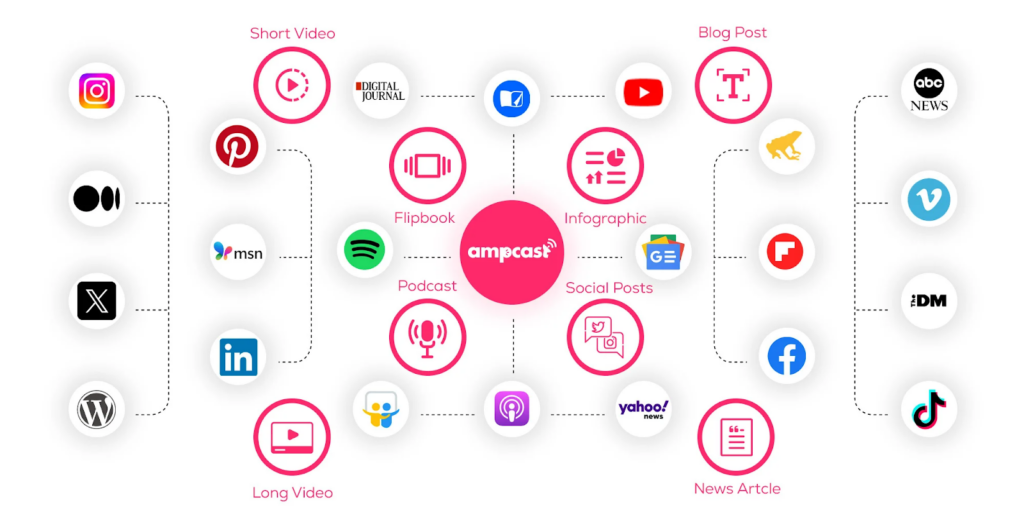
The hard truth is that press releases — no matter how well-crafted — are a single-channel, short-lived format. They reach one audience in one place at one time. In a world where your customers are spread across Google, YouTube, Instagram, Spotify, and dozens of other platforms, relying on a press release alone leaves the vast majority of your audience untouched. That’s exactly the problem AmpiFire was built to solve.
Instead of relying on a single press release and hoping for the best, AmpCast AI automatically transforms your core message into 8 distinct content formats: news articles, blog posts, interview podcasts, longer informational videos, reels/shorts, infographics, flipbooks/slideshows, and social posts. Each piece is individually crafted and optimized, and your message is shaped to perform natively on every platform it touches.
Then comes the distribution. AmpCast automatically pushes your content across a network of over 300 high-traffic sites, placing your brand in front of audiences you’d never reach through traditional press release distribution alone. This results in sustained, multi-channel visibility, not a one-day spike followed by silence, while maintaining consistent messaging across all platforms.
Ready to Go Multi-Channel? Try AmpiFire Today →
Frequently Asked Questions (FAQs)
How long should a call to action be in a press release?
The ideal call to action in a press release is 5–15 words. This length provides enough space to include a strong action verb, clear direction, and brief value statement without becoming cumbersome.
Is it appropriate to include multiple CTAs in one press release?
While technically possible, including multiple CTAs in a single press release typically reduces overall effectiveness by creating decision fatigue and confusion about the primary desired action.
Alternatively, consider creating multiple versions of your press release, each targeting a specific audience segment with a customized CTA relevant to their particular interests and needs.
Can a CTA be too promotional for a press release?
Yes, a CTA can undermine a press release’s effectiveness when it shifts from guiding readers to relevant information to overt sales language. The key distinction lies in whether your CTA serves the reader’s information needs or solely pushes for commercial transactions.
Appropriate press release CTAs extend the news value by directing readers to related resources, detailed information, or relevant context that enhances their understanding of the announcement.
Should my press release CTA link directly to a product page or somewhere else?
Your press release CTA should link to the destination that most directly fulfills the promise made in the call to action. If your CTA offers additional information about research findings, link to the full report rather than a product page.
How does AmpiFire’s AmpCast outperform traditional press releases?
AmpiFire’s AmpCast AI outperforms traditional press releases by automatically turning one announcement into eight distinct content formats and distributing them across 300+ high-traffic channels.
Instead of a short-lived media push, it delivers sustained visibility across search, video, audio, and social, maximizing reach and long-term brand impact.
*Disclaimer: Results may vary based on individual circumstances, business type, and content strategy. The time savings and outcomes mentioned are based on typical user experiences and are not guaranteed. For specific pricing and service details, please visit AmpiFire.